Blog · Records
Who's actually the fastest Sudoku solver on Earth?
You finished today's puzzle and felt pretty good about your time. Now meet the chemist who solved an Easy grid, on paper, in front of an audience, in 2 minutes and 8 seconds — and the man who's won more World Sudoku Championships than anyone alive.
Published 2026-07-26 · 9 min read
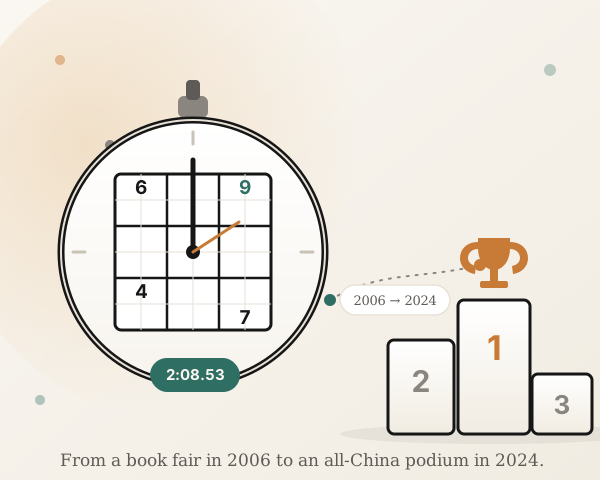
Two very different things get called a "Sudoku world record," and mixing them up is the most common mistake in every forum thread about this topic. One is a Guinness-certified sprint: a single person, against a stopwatch, on one specific puzzle. The other is a twenty-year-old team sport most people have never heard of, with its own federation, its own rivalries, and — as of this year — a genuinely new champion. Here's both, with the receipts.
The fastest Sudoku ever officially timed
On 20 May 2006, at BookExpo America in Washington, D.C., a puzzle constructor named Thomas Snyder sat down under Guinness World Records supervision and set two records that still stand:
- Fastest "Very Easy" Sudoku: 1 minute 23.93 seconds
- Fastest "Easy" Sudoku: 2 minutes 8.53 seconds
The puzzles were set by fellow constructor Mike Mepham under the International Sudoku Organisation, timed live, pencil and paper only. Nearly two decades on, both records are unbroken. If today's Easy board takes you longer than that — and for almost everyone, it will — you're in exactly the company you'd expect to be in.
The other kind of record: the World Sudoku Championship
Separate from any stopwatch, there's a real annual event most casual players never learn exists: the World Sudoku Championship (WSC), run by the World Puzzle Federation since 2006. It's not a single puzzle — it's a multi-day tournament of 100+ puzzles across timed rounds, including a "Relay" round (your answer feeds digits into the next grid) and, fittingly, a "World Record" round where competitors chase a fresh Guinness time live on stage. The first champion, in Lucca, Italy in 2006, was Jana Tylová of the Czech Republic — the tournament's inaugural winner was a woman, a detail that tends to surprise people who assume this is a niche men's hobby.
The most decorated Sudoku player alive
Kota Morinishi of Japan holds the record for individual WSC titles — four, won in 2014, 2015, 2017 and 2018. What makes it a real story rather than just a stat: his first appearance at the Championship, in Philadelphia in 2010, ended in 25th place. It took four more years of returning before he won anything. He's still competing at the top level fifteen years later — he took silver again in 2025, behind China's Dai Tantan — which says more about persistence than any single fast time does.
Dr. Sudoku: the record-holder with a day job
Thomas Snyder — the same person who set the 2006 speed records — also won the WSC three times (2007, 2008, 2011) and, in 2018, became the first person to win both the World Sudoku Championship and the World Puzzle Championship. He writes puzzles under the name Dr. Sudoku — a nod to his real academic background: chemistry degrees from Caltech and Harvard, plus postdoctoral research at Stanford. Asked about his career by TIME magazine, he said plainly:
"My goal is to be known for the science I do rather than the sudoku."
Nearly twenty years later, the sudoku is what stuck. That's not a criticism of him — it's a fairly honest snapshot of how far a newspaper puzzle can outgrow the people who mastered it first.
Who's actually winning right now
Japan is still the most successful team in the event's history — six titles between 2007 and 2023. But China has now matched that pace, with five team titles of its own (2013, 2017, 2019, 2024 and 2025), including the last two years running. The most striking single result came at the 2024 Beijing Championship, held on home soil, where China didn't just win — it swept the entire individual podium: gold, silver and bronze, all three Chinese competitors.
| Year | Host city | Individual gold | Team gold |
|---|---|---|---|
| 2019 | Kirchheim, Germany | Ken Endo (Japan) | China |
| 2022 | Kraków, Poland | Tiit Vunk (Estonia) | Czech Republic |
| 2023 | Toronto, Canada | Dai Tantan (China) | Japan |
| 2024 | Beijing, China | Ming Letian (China) | China |
| 2025 | Eger, Hungary | Dai Tantan (China) | China |
Source: World Puzzle Federation results, via the World Sudoku Championship record. The 2025 Championship (Eger, Hungary) was the most recent one held at time of writing.
The weirder records nobody asks about
A few Guinness entries exist purely because someone, somewhere, decided to try: the largest connected multi-Sudoku puzzle ever made had 280 linked grids (Japan, October 2018), and the record for most people solving Sudoku simultaneously in one place is 3,824 people (India, January 2016) — an entire stadium's worth of humans, all doing the same nine digits at once. Sudoku also has a small broadcast history: Sudoku Live on Sky One was the first television programme built around it. None of this changes how you play your daily puzzle, but it's a reminder that somewhere, someone has taken this exact hobby to an extreme you probably never considered.
What this actually means for the rest of us
Every record in this post is an outlier by design — that's the point of a record. The same three rules that Howard Garns wrote down on a 1979 magazine page can apparently be pushed all the way to a 2-minute solve time and a fifteen-year competitive career, which says something real about how much depth was hiding in what looks like a simple number grid. You don't need to shave your time down to Thomas Snyder's, and you're never going to accidentally end up on a WSC podium. The useful takeaway is smaller and more personal: pick a difficulty, time yourself honestly, and try to beat your own number tomorrow. That's a competition you can actually win.
FAQ
- What is the world record in Sudoku?
- There isn't one single record — Guinness certifies fastest times by difficulty. Thomas Snyder holds both: 2 minutes 8.53 seconds for an “Easy” grid and 1 minute 23.93 seconds for a “Very Easy” grid, both set on 20 May 2006 at BookExpo America in Washington, D.C. Separately, the record for most World Sudoku Championship titles is four, held by Kota Morinishi of Japan.
- What is an impressive Sudoku time?
- There's no official benchmark for casual players, so treat Snyder's 2:08.53 as the ceiling, not a target: it's a certified world record set live, under competition rules, by a repeat champion. If your own daily Easy puzzle takes ten or fifteen minutes, that's completely normal — you're comparing yourself to a genuine outlier, not an average.
- If a computer can solve any Sudoku instantly, why do humans still compete?
- Because the competition banned computers from the start. World Sudoku Championship rules require pencil and paper, no calculators, no apps — the same reason chess grandmasters still compete despite engines like Stockfish being unbeatable. The test isn't “can this be solved,” it's “how fast can a trained human mind do it under pressure,” which is a genuinely different — and still unsolved by machines in a fair, timed, human contest — question.
- Do Sudoku world champions get paid to do this?
- Not in any way that's publicly documented. Thomas Snyder, the most decorated American Sudoku player, holds chemistry degrees from Caltech and Harvard and did postdoctoral research at Stanford — and once told TIME magazine, “My goal is to be known for the science I do rather than the sudoku.” For almost everyone at this level, competing is a serious hobby stacked on top of an unrelated career, not a paycheck.
- Could a regular player ever actually compete at Worlds?
- Technically, yes — the World Puzzle Federation has roughly 30 member countries, several of which (including the UK, India, Australia and Singapore) run their own national qualifying events that feed into the World Championship. Realistically, the people on that podium have been training for years. The far more useful goal for most of us: beat your own best time on today's board, not Thomas Snyder's.
Keep reading
Time yourself against the record: Easy Sudoku · the full 1979-to-today story: History of Sudoku · the hardest puzzle ever published (a very different kind of "extreme"): hardest Sudoku ever · build actual speed with technique, not luck: Sudoku strategies · see how the four difficulty bands compare: Sudoku difficulty levels.
Ready to set your own personal best? Play today's Sudoku — new board, every day, no signup.
Go set your own record
- Easy Sudoku
- Blog
- History of Sudoku
- Play Sudoku
- Online Sudoku
- Sudoku puzzles
- Sudoku game
- Daily Sudoku
- Classic Sudoku
- Medium
- Hard
- Expert
- Evil
- Extreme
- Mini Sudoku
- Kids Sudoku
- Beginner
- Solver
- Printable
- Sudoku PDF
- What is Sudoku?
- How to solve
- Strategies
- Techniques
- Variants
- Unlimited
- No ads
- App
- Tips & tricks
- Get better
- Learn
- All pages