Blog · Origins
The history of Sudoku, from magazine page to daily habit
Sudoku's grid was invented in America, its name and house rules came from Japan, and its global fame was lit by a retired judge in Hong Kong. Here's the real timeline, in order, with sources.
Published 2026-07-26 · 8 min read
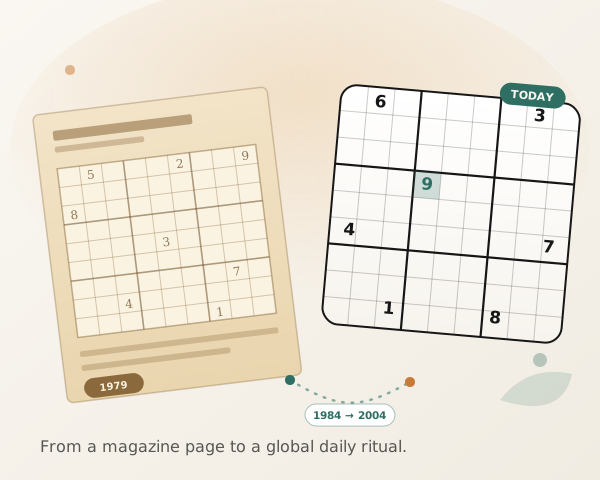
Ask ten people who invented Sudoku and you'll get ten different answers — Japan is the most common guess, and it's only half right. The truth runs through a Swiss mathematician, a retired American architect, a Japanese publishing house, and a retired Hong Kong judge, in that order, over roughly two centuries. None of them met each other. Each one added exactly the piece the puzzle was missing.
Before Sudoku: Euler's Latin squares
The mathematical skeleton of Sudoku predates the puzzle by two hundred years. In the 1780s the Swiss mathematician Leonhard Euler studied Latin squares — grids where every symbol appears exactly once in every row and every column. Euler had no interest in puzzles for their own sake; he was researching combinatorics. A Latin square has no 3×3 box rule and no puzzle to solve — every cell is already filled in. Sudoku is best described as a Latin square with one extra constraint (the boxes) and most of the grid erased, which is what turns a piece of maths into something you can actually play.
1979 — Howard Garns and "Number Place"
The puzzle as we'd recognise it first appeared in the American magazine Dell Pencil Puzzles and Word Games in 1979, under the name Number Place. It's widely credited to Howard Garns, a 74-year-old retired architect and freelance puzzle constructor from Indiana. Garns added the 3×3 box constraint that Euler's Latin squares never had, and — crucially — designed it as a puzzle with a single starting grid and a single correct solution, rather than a completed curiosity.
1984 — Nikoli names it "Sudoku"
The Japanese puzzle publisher Nikoli reprinted Number Place in 1984 under the title Sūji wa dokushin ni kagiru — "the digits must remain single" — soon shortened to Sudoku. Nikoli's president at the time, Maki Kaji, is generally credited with the name and with championing the puzzle in Japan. Over the next two years Nikoli refined the format into the house rules that still define a "proper" Sudoku today: a symmetrical pattern of givens and, above all, exactly one solution reachable by logic — no guessing required. (The mathematical proof that 17 clues is the minimum for that to hold wasn't published until 2012 — see the hardest Sudoku ever page for that story.) For the full word-by-word translation, see our Sudoku meaning guide.
2004 — Wayne Gould and The Times of London
Sudoku stayed a Japanese niche puzzle for two decades. That changed because of Wayne Gould, a retired Hong Kong judge who spotted a Sudoku book in a Tokyo bookshop in 1997. Gould spent roughly six years of his retirement writing a computer program capable of generating fresh, uniquely-solvable Sudoku puzzles on demand — the single biggest unlock for mass newspaper publication, since hand-built puzzles couldn't scale to a daily print run. He pitched the puzzles to The Times of London, which published its first Sudoku on 12 November 2004. Britain caught what the press nicknamed "Sudoku fever" within weeks.
2005 onward — the global boom
The New York Times added a daily Sudoku in 2005, and syndicated newspapers on every continent followed within about a year — an unusually fast spread for a puzzle with zero language dependency (a 9 is a 9 in every alphabet). By 2006 Sudoku competitions were running internationally, and by 2008 the first wave of smartphone apps had turned a newsprint puzzle into something people carried in their pocket. That shift — from a page you'd finish once and discard, to a board that regenerates every day — set up the format most people play in today.
The full timeline
| Year | What happened | Where |
|---|---|---|
| 1782 | Leonhard Euler formalises the Latin square — the maths that underlies Sudoku, with no puzzle attached yet. | Switzerland |
| 1979 | Howard Garns designs "Number Place" for Dell Pencil Puzzles and Word Games. | United States |
| 1984 | Nikoli publishes the puzzle as Sūji wa dokushin ni kagiru — shortened to Sudoku. | Japan |
| 1986 | Nikoli fixes the modern house rules: symmetrical givens and exactly one logical solution. | Japan |
| 2004 | Wayne Gould's puzzles launch in The Times of London, igniting the UK craze. | United Kingdom |
| 2005 | The New York Times adds a daily Sudoku; the puzzle goes global within a year. | United States → worldwide |
| 2008+ | Smartphone apps turn Sudoku into an anytime, anywhere habit. | Worldwide |
| Today | Instant online boards (no app, no print) make daily Sudoku a one-tap habit. | Worldwide |
Same three rules for 45 years — row, column, box, each digit once. Only the medium keeps changing: magazine page, newspaper column, app, browser tab.
Where Sudoku is today
The newest chapter isn't a new rule — it's a new medium. Printed Sudoku hasn't gone away (see our printable packs), but most solving now happens on a screen, often as a one-tap daily habit rather than a purchase. That's the model Zeloku's daily board follows: a fresh, uniquely-solvable puzzle every day, in four difficulty bands, with no app install and no paywall — the direct descendant of Wayne Gould's generator, minus the newspaper in between.
FAQ
- Who invented Sudoku?
- The grid itself — under the name "Number Place" — was designed by Howard Garns, a retired American architect and freelance puzzle constructor, for Dell Pencil Puzzles and Word Games in 1979. The name "Sudoku" and the puzzle's modern house rules (symmetrical givens, a single logical solution) came five years later from the Japanese publisher Nikoli. Both steps mattered: Garns invented the grid, Nikoli turned it into the puzzle people recognise today.
- Is Sudoku Japanese or American?
- Both, depending on which part you mean. The puzzle mechanic was invented in the United States in 1979. The name "Sudoku" and the puzzle's popularisation as a distinct genre happened in Japan from 1984 onward, via the publisher Nikoli. The global boom that made it a household name started in the United Kingdom in 2004.
- Why is it called Sudoku?
- Sudoku is a shortened form of the Japanese phrase sūji wa dokushin ni kagiru, roughly "the digits must remain single" — a reference to the rule that each digit appears only once per row, column and box. Nikoli's president at the time, Maki Kaji, is widely credited with the name. For the full etymology and pronunciation, see our Sudoku meaning guide.
- When did Sudoku become popular worldwide?
- 2005. Wayne Gould, a retired Hong Kong judge, spent about six years writing a computer program that could generate Sudoku puzzles quickly, then persuaded The Times of London to run one — the first appeared in November 2004. The UK caught "Sudoku fever" within months, The New York Times added a daily puzzle in 2005, and newspapers worldwide followed within about a year.
- Will we ever run out of new Sudoku puzzles?
- No. There are about 6.67 × 10²¹ valid completed 9×9 Sudoku grids — a number so large that generating a fresh, unique puzzle every day for the rest of human history would barely dent it. See our Unlimited Sudoku page for the full maths.
Keep reading
Full word-by-word etymology: Sudoku meaning · rules and definitions: What is Sudoku? · the maths of how many puzzles exist: Unlimited Sudoku · the toughest puzzle ever published: hardest Sudoku ever · how Nikoli's rules evolved into today's variants: Sudoku variants · the puzzle Nikoli built on top of the original grid: Killer Sudoku rules.
Want to try the puzzle Garns designed and Nikoli named, in the form Gould's generator made possible? Play today's Sudoku or start with the six-step solving method.
Play the puzzle behind the history
- Blog
- Sudoku meaning
- Hardest Sudoku ever
- Play Sudoku
- Online Sudoku
- Sudoku puzzles
- Sudoku game
- Daily Sudoku
- Classic Sudoku
- Easy
- Medium
- Hard
- Expert
- Evil
- Extreme
- Mini Sudoku
- Kids Sudoku
- Beginner
- Solver
- Printable
- Sudoku PDF
- What is Sudoku?
- How to solve
- Strategies
- Techniques
- Variants
- Unlimited
- No ads
- App
- Tips & tricks
- Get better
- Learn
- Sudoku world records
- All pages